Generic international SEO approaches fail in Gulf bilingual eCommerce as they ignore Arabic language nuances, Gulf-specific search behavior, incorrect hreflang implementation, and technical localization. Businesses that optimize bilingual architecture, regional indexing, and user intent improve organic visibility, search rankings, and customer experience across the UAE and neighboring GCC markets.
Key Takeaways
- Correct hreflang tags improve regional language targeting.
- Gulf Arabic and Arabizi require dedicated keyword optimization.
- Localized infrastructure enhances bilingual website performance.
- Search intent differs significantly between Arabic and English users.
Despite heavy investment in international SEO, many Gulf e-commerce platforms struggle with keyword cannibalization and indexation errors across Arabic and English search results.
- The e-commerce market of the UAE reached $8.8 billion (AED 32.3 billion) in 2024, and by 2029, it is expected to exceed $13.8 billion (AED 50.6 billion), increasing competition for organic visibility across both Arabic and English search results.
Successful optimization requires technical localization alongside multilingual content. It includes implementing proper hreflang tags, optimizing metadata and URLs for each language, aligning keywords with local search behavior, and creating culturally relevant content that matches how users search in both Arabic and English.
But despite these strategies, what affects the standard global SEO of e-commerce companies? What are the constraints businesses should address? Let’s explore.
Why Do Traditional Hreflang Implementations Break Down on Gulf E-Commerce Platforms?
Traditional hreflang implementations fail on Gulf e-commerce platforms, as they overlook country-specific language targeting, bilingual search behavior, and localized URL structures, leading to indexing conflicts and reduced regional search visibility.
- Many businesses often opt for global multilingual technical SEO services without considering Gulf-specific language behavior.
- Search engines often struggle to determine which Arabic or English version should rank when hreflang attributes, canonical tags, and localized URLs are improperly configured.
As a result, pages compete against one another, leading to inefficient indexing and weaker visibility.
- According to the Arab Federation for Digital Economy, the UAE’s digital economy is expected to contribute 19.4% of national GDP in the following decade, highlighting the growing importance of optimizing multilingual online experiences for regional audiences.
The table below highlights key SEO elements and their impact on ranking, driven by standard global and localized GCC bilingual strategy.
| SEO Element | Standard Global Strategy | Localized GCC Bilingual Strategy | Impact on Rankings |
| Hreflang Tagging | Language-only implementation | Region-specific Arabic-English targeting | Better indexing accuracy |
| Language Mapping | Generic multilingual pages | UAE- and GCC-focused localization | Higher relevance |
| URL Structure | Single international structure | Country-language URL hierarchy | Improved regional visibility |
Table 1: SEO Elements and their Impact on Rankings
Implement Accurate Hreflang Tags for Multi-Country Gulf Storefronts
Bilingual Gulf stores should implement language-region combinations such as ar-AE, en-AE, ar-SA, and en-SA instead of relying solely on language codes. But why? What are the benefits of these combinations? Here’s our answer.
- Serves the correct language and regional currency version to users across individual GCC territories, improving search relevance.
- Reduces duplicate content issues through accurate language and regional targeting.
- Enhances user experience by displaying content tailored to local language preferences.
- Strengthens search engine indexing with clearer hreflang signals for multilingual pages.
- Increases organic traffic by matching country-specific search intent.
Businesses investing in technical SEO services can ensure hreflang annotations remain consistent across multilingual product pages, preventing duplicate content issues while improving crawl efficiency.
Tip: Never use one canonical URL across multiple Gulf country versions. Each localized storefront should maintain its own canonical reference to preserve regional search relevance.
How Does Ignoring Local Arabic Dialects and Arabizi Affect Search Visibility?
Ignoring local Arabic dialects and Arabizi reduces search visibility by failing to match real user queries, causing lower rankings, reduced organic traffic, and missed high-intent customers across Gulf markets.
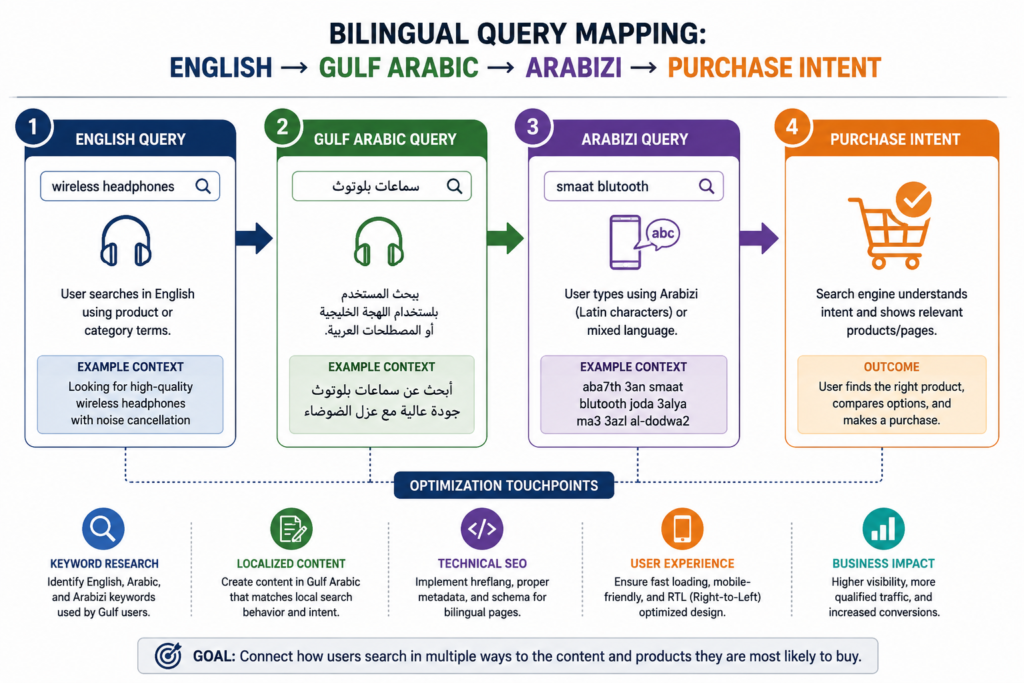
- Arabic search behavior in the Gulf differs significantly from Modern Standard Arabic. Consumers frequently search using local dialects, mixed Arabic-English phrases, or Arabizi (Arabic written in Latin characters).
- Literal translations often fail to capture commercial search intent, resulting in lower rankings despite technically optimized pages.
Build a localized SEO strategy by incorporating Gulf Arabic dialects, Arabizi, and bilingual keyword research to better align with regional search intent, improve keyword relevance, and increase organic visibility across UAE and GCC markets.
According to the Telecommunications and Digital Government Regulatory Authority (TDRA), the number of internet users in the UAE reached 99%, while mobile usage dominates online shopping practices on a significant scale. It makes localized keyword targeting essential for reaching multilingual consumers effectively.
Target High-Intent Regional Dialects and Colloquial Terminology
Successful Gulf retailers often focus on how local consumers naturally search for products instead of relying on literal, word-for-word translations of product catalogs. Their SEO strategies involve optimizing content using regional Arabic dialects, bilingual search patterns, and culturally relevant terminology to better match user intent, improve search visibility, and drive higher engagement and conversions.
- For example, UAE shoppers may alternate between English product names and Arabic descriptions depending on familiarity, product category, and purchase intent.
Professional technical SEO services combined with localized SEO practices help businesses map bilingual product pages to authentic Gulf search behavior rather than relying on automated translation. However, integrating local SEO services in Dubai with multilingual campaigns improves regional discoverability for businesses targeting both local and international audiences.
Lubnanona helps UAE businesses develop bilingual digital strategies that align Arabic and English content with regional customer behavior, supporting stronger search visibility across GCC markets.
Capture Conversational Search Traffic and “Arabizi” Queries
Since Gulf consumers naturally mix Arabic and English when searching online, queries written in Arabizi (Arabic using Latin characters) are common on mobile devices and conversational searches.
According to a study published in the Wiley Online Library, 44% of surveyed UAE residents identify both Arabic and English as their primary languages. It emphasizes the need for bilingual keyword optimization in Gulf eCommerce.
- Optimizing metadata, FAQs, schema markup, and product descriptions for these variations enables search engines to understand multilingual intent, essential for international ranking.
- Businesses using technical SEO services should also incorporate conversational keyword variations into structured data instead of relying solely on machine-translated content.
- A comprehensive SEO strategy, including real customer language patterns, improves visibility for voice search and AI-generated search results.
The table below highlights search behaviors of Gulf country consumers, SEO recommendations, and relevant business benefits.
| Search Behavior | SEO Recommendation | Business Benefit |
| English Search | Optimize English keywords and metadata | Reaches expatriate and international audiences |
| Gulf Arabic Search | Use localized Gulf Arabic keywords instead of literal translations | Improves relevance for native Arabic speakers |
| Arabizi Search | Include Arabizi keyword variations in FAQs, schema, and supporting content | Captures additional mobile and conversational searches |
| Mixed-Language Search | Optimize bilingual content and internal linking | Matches real-world bilingual search intent and improves visibility |
Table 2: Common Bilingual Search Behaviors in the Gulf
Tip: Automated translation cannot replace native keyword research. Regional linguistic expertise helps identify commercial search terms that machine translation frequently misses.
What Technical Infrastructure Issues Block Indexing for Arabic-English Online Stores?
Beyond content localization, technical infrastructure significantly influences bilingual search performance. Right-to-left (RTL) layouts, multilingual JavaScript rendering, inconsistent internal linking, and slow server response times can delay crawling and indexing. Search engines prioritize fast, mobile-friendly websites that deliver seamless experiences across both language versions.
Optimize Server Response Times via Regional Middle Eastern CDNs
Optimizing bilingual e-commerce websites on regional Content Delivery Networks (CDNs) with edge locations in Dubai and Riyadh reduces latency and improves Core Web Vitals. Faster-loading pages enhance user experience while helping search engines crawl multilingual content more efficiently.
Google’s Web.dev suggests that improving Core Web Vitals contributes to better user experience and supports stronger search performance. Combined with technical SEO services, regional hosting ensures Arabic and English pages remain accessible, responsive, and indexable.
- UAE businesses should integrate local SEO services in Dubai with their multilingual optimization efforts to strengthen regional visibility.
- A data-driven SEO strategy, combining technical infrastructure, localized content, and performance optimization, offers sustainable organic growth across GCC markets.
Lubnanona offers customized bilingual Search Engine Optimization (SEO) solutions, helping brands build scalable Arabic-English websites that improve indexing, user engagement, and long-term organic performance across the UAE and wider GCC region.
Case Study
A Dubai-based online home decor retailer experienced inconsistent rankings since its Arabic service pages used to take more time to load, compared to its English pages, and lacked proper hreflang implementation.
After deploying a regional CDN, optimizing Core Web Vitals, implementing ar-AE and en-AE hreflang tags, and refining its SEO strategy with localized Arabic keywords, the business achieved significantly faster page loads, improved indexing consistency, and stronger visibility for both Arabic and English search queries. Eventually, it experienced improved organic engagement (30-35%) and improved multilingual user experience across the Dubai market.
Tip: Always test RTL pages for Mobile-First Indexing. Responsive layouts, readable typography, and optimized images should perform consistently in both Arabic and English interfaces.
Wrapping Up
Bilingual Gulf e-commerce success depends on more than translating website content. Businesses that prioritize technical localization, regional search intent, and Arabic-English optimization create stronger digital experiences and achieve better long-term organic performance. A localized approach ensures greater visibility, improved customer engagement, and sustainable online growth throughout the GCC.
Looking To Strengthen Your Bilingual Online Presence?
Lubnanona offers customized SEO solutions designed for UAE businesses, helping improve multilingual website performance, regional visibility, and long-term search growth through data-driven optimization and technical expertise. Contact us for bilingual, market-specific services to connect with Arabic- and English-speaking audiences while ensuring stronger search rankings and higher conversion opportunities across the GCC.
Frequently Asked Questions(FAQs)
1. Should GCC Websites Use Subfolders or Subdomains for Multilingual SEO?
Both approaches can work effectively. The choice depends on your website architecture, but consistency, proper hreflang implementation, and strong internal linking are more important than the URL format itself.
2. How Does Google Interpret Arabic Dialects in E-Commerce Searches?
Google recognizes differences between Modern Standard Arabic, Gulf dialects, and conversational search patterns. Optimizing for localized keywords improves relevance and search visibility.
3. What Is the Correct Hreflang Setup for UAE Bilingual Stores?
Implement language-region attributes such as ar-AE and en-AE while maintaining self-referencing canonical tags for each localized page. It helps search engines serve the correct regional version to users, reducing duplicate content issues and improving multilingual search visibility.
4. Why Is Arabizi Important for Gulf SEO?
Many users type Arabic words using Latin characters (Arabizi), particularly on mobile devices where switching keyboards can be inconvenient. Incorporating relevant Arabizi variations into keywords, metadata, and content helps capture additional high-intent search traffic while improving visibility for conversational and multilingual searches across Gulf markets.
5. Why Are Regional CDNs Beneficial For Bilingual Websites?
Regional CDNs reduce latency, improve page speed, strengthen Core Web Vitals, and enable search engines to crawl Arabic and English content more efficiently. They also deliver a faster, more consistent user experience across GCC markets, helping increase engagement, reduce bounce rates, and support higher search rankings.